Mistletoe Therapy for Prostate Cancer
- October 11, 2024
- Written by : Rebecca LaMarca, MSN, APN-BC, CNS
In recent years, mistletoe extract has been studied as an integrative support option for people recovering from various cancers, including prostate cancer. When used alongside conventional treatments, mistletoe therapy may offer benefits that make cancer recovery easier, such as reduced chemo side effects. Here’s what you should know about this complementary care option and how to find integrative prostate cancer support in New Jersey, New York City, and Philadelphia.
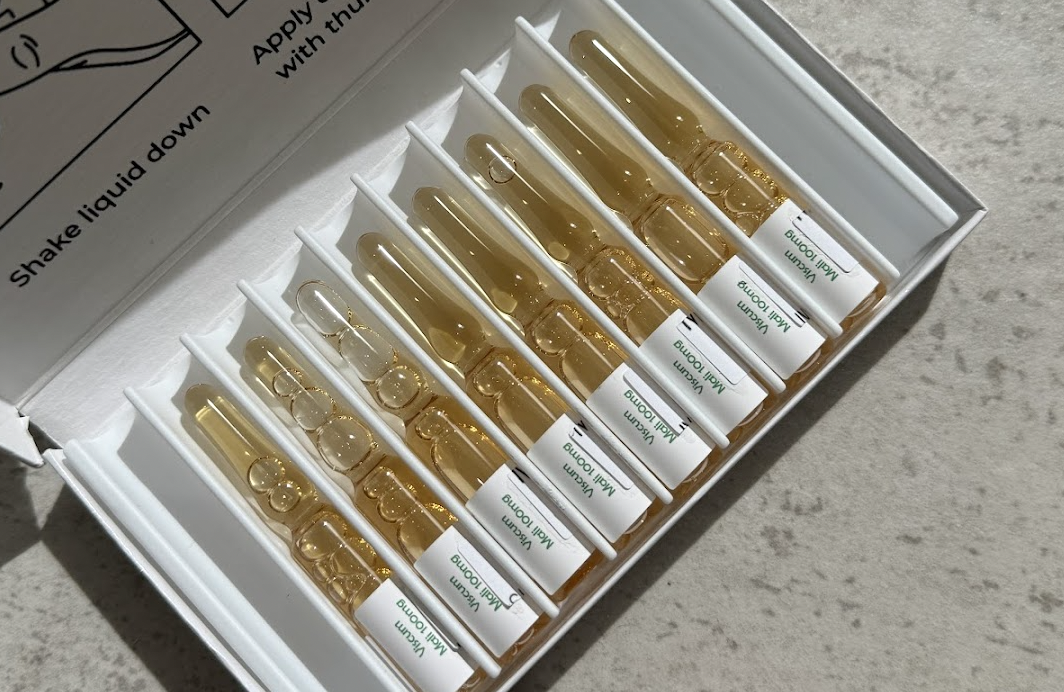
Disclaimer: The FDA does not endorse mistletoe as a cancer treatment and does not recommend it as a substitute for standard care. It should only be considered as a complementary therapy alongside FDA-approved conventional cancer treatments.
Can mistletoe therapy support patients with prostate cancer?
Research suggests that mistletoe therapy may support patients with prostate cancer when used in conjunction with conventional treatments like chemotherapy, radiation, or prostate cancer surgery. That’s because the mistletoe plant contains proteins called lectins, which may affect the immune system and the progression of tumors.
In particular, though more research is needed, mistletoe therapy might support prostate cancer recovery by reducing side effects of chemotherapy and radiation, such as fatigue and nausea, and by strengthening the immune system. It is also being studied for potential effects on tumor activity in lab and clinical research.
One well-known supporter of mistletoe therapy is Dr. Channing Paller, the Director of Prostate Cancer Clinical Research at Johns Hopkins. He has advocated for the treatment for at least a decade.
“In the past, doctors may have wondered if they were giving their patients snake oil. But I think people are becoming a little more open-minded. We don’t treat these natural products any differently than any other immunotherapy trial that we do. Every new potential treatment, including natural products such as herbs, needs to be studied rigorously and go through all FDA-required testing before it can be given to a patient.” — Dr. Channing Paller, 2014 Johns Hopkins Magazine
In 2023, Dr. Paller led a team of researchers in a Phase 1 trial evaluating mistletoe extract in advanced cancers, including prostate cancer.
What did the 2023 Johns Hopkins mistletoe prostate trial find about advanced cancers?
The 2023 Johns Hopkins mistletoe trial found that mistletoe IV therapy might improve treatment outcomes for people with advanced cancers, including prostate cancer, though more research is needed.
| Trial Element | Detail |
|---|---|
| Study | Phase I trial of intravenous mistletoe extract in advanced cancer |
| Lead investigator | Dr. Channing Paller, Director of Prostate Cancer Clinical Research at Johns Hopkins |
| Published | 2023 · Cancer Research Communications |
| Trial design | Dose-escalation Phase I trial |
| Participants | 21 patients with advanced, treatment-resistant cancers (including prostate) |
| Treatment frequency | 3 IV infusions per week |
| Maximum tolerated dose | 600 mg mistletoe extract |
| Reported side effects | Fatigue, nausea, chills — described as manageable |
| Quality of life | Overall improvement reported by patients |
| Disease stability | 5 patients experienced stable disease (average 15.3 weeks) |
| Tumor response | 3 patients experienced tumor shrinkage — did not meet formal response criteria |
| Conclusion | Phase II trial warranted to determine optimal dosing and further evaluate safety |
For the trial, Dr. Paller and his team examined the use of intravenous mistletoe extract in 21 people with advanced, treatment-resistant cancers. The researchers wanted to identify the safest maximum dose of mistletoe extract for future studies.
Three times a week, participants were given increasingly higher doses of mistletoe extract intravenously. The researchers identified the safest maximum dose as 600 milligrams. Patients tolerated the therapy well, reporting manageable side effects like fatigue, nausea, and chills. They also reported an overall improved quality of life.
In addition, the research team observed stable disease in five of the participants, which lasted 15.3 weeks on average. Three participants also experienced tumor shrinkage for a few months, but the shrinkage did not meet official criteria to count as a significant treatment response.
Ultimately, Dr. Paller and his team concluded that a Phase II trial is needed to determine proper dosing and further evaluate the safety of mistletoe extract therapy for patients with advanced cancer.
Dr. Paller’s other research on integrative care for prostate cancer
As part of his broader integrative oncology research, Paller also joined a team of researchers to examine the efficacy of muscadine grape skin extract (MSKE) as a support option for prostate cancer recovery. MSKE contains compounds called polyphenols, which are studied for their antioxidant and anti-inflammatory effects.
The research team found that MSKE could inhibit prostate tumor growth and migration. They suggested it should be studied as a pre-treatment or complementary care option for patients who have not responded to traditional prostate cancer medications and treatments. 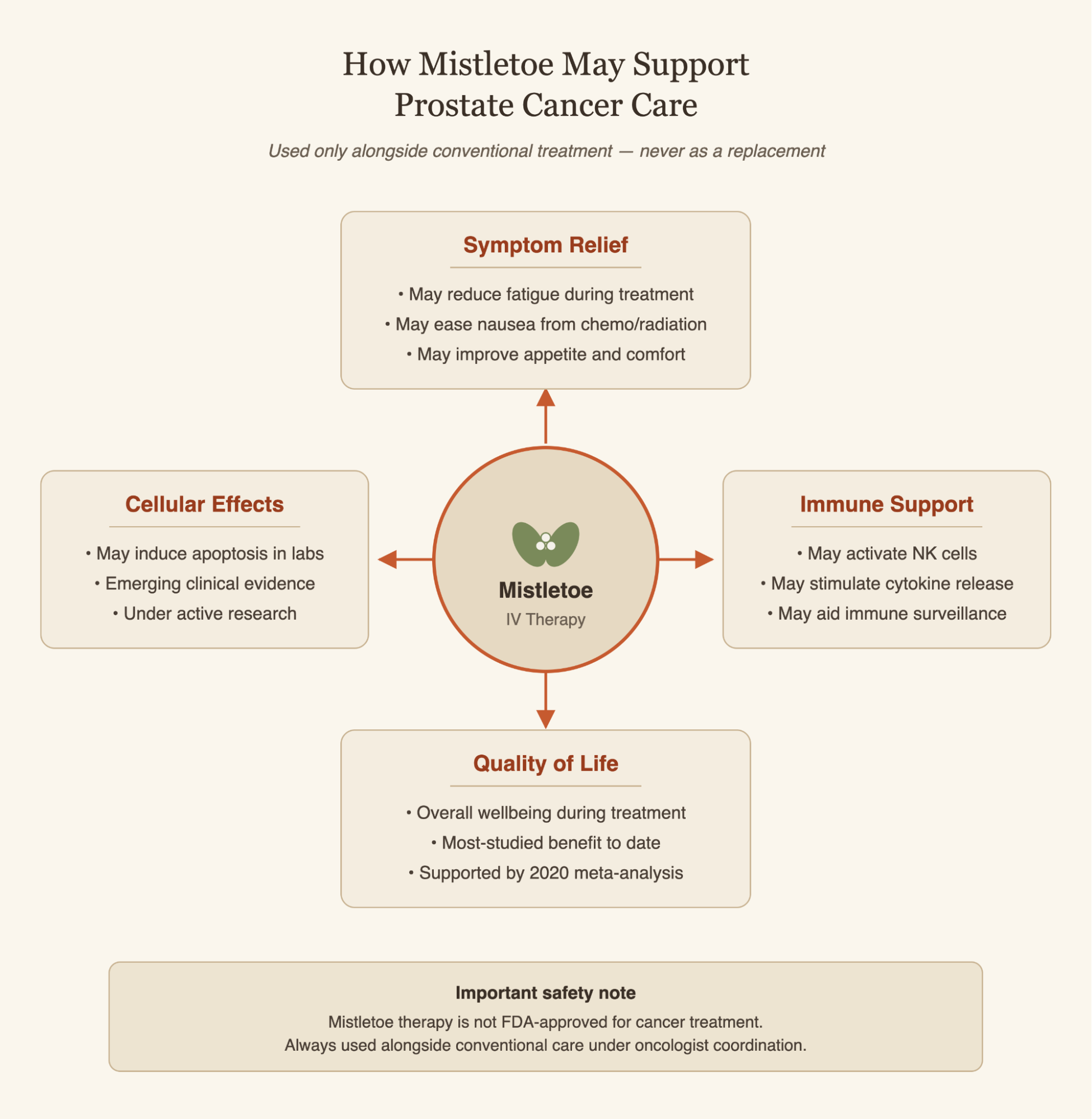
Is mistletoe therapy a substitute for prostate cancer treatment?
No. Mistletoe therapy should never be used as a substitute for treatment at any prostate cancer stage, as the FDA has not approved it to treat any type of cancer. Instead, it should only be used in integrative care settings alongside conventional, FDA-approved treatments like chemotherapy and radiation, which have been linked to higher prostate cancer survival rates. Always talk to your oncologist and cancer care team before starting mistletoe therapy or any new treatment.
Are there integrative options for men with advanced prostate cancer in the tri-state area?
Yes. The clinical team at IV Elements offers integrative care options for men with advanced prostate cancer at our New Jersey drip lounges in Hoboken, Asbury Park, Parsippany, and Marlton. We also provide in-home services across NJ, NYC, Philadelphia, and Bucks County, PA. That means you can comfortably receive integrative support from licensed healthcare professionals right at home.
Our certified nurses offer personalized mistletoe therapy combined with high-dose vitamin C, which may help you feel more comfortable during conventional cancer treatments such as chemotherapy and radiation.
One of our clients came to us with stage 3 prostate cancer, deciding to enhance his treatment plan with alternative medicine. We worked with him to create an individualized mistletoe therapy plan that met his specific needs and then tracked his responses to treatment over time. After one month of mistletoe treatment, our client saw his condition improve.
Explore integrative cancer care at IV Elements
If you or someone you love is recovering from prostate cancer, the compassionate team at IV Elements is here to support your journey. Certified in mistletoe therapy by the Physicians’ Association for Anthroposophic Medicine (PAAM), our nurses are proud to provide holistic care for prostate cancer patients in the NYC tri-state region.
As members of the Society for Integrative Oncology (SIO), we offer in-lounge services in Hoboken, Asbury Park, Parsippany, and Marlton, NJ along with mobile services throughout NJ, NYC, and Philadelphia. Schedule a consultation today!
Frequently Asked Questions
What is Dr. Channing Paller’s research on mistletoe?
In 2023, Dr. Channing Paller led a team of researchers in a Phase 1 trial that examined the use of intravenous mistletoe extract in people with advanced cancers. Patients reported manageable side effects like fatigue, nausea, and chills. They also reported an improved quality of life, with some experiencing stable disease and tumor shrinkage. However, future trials are needed to confirm the safety and effectiveness of mistletoe therapy for cancer patients.How does mistletoe therapy fit alongside conventional prostate cancer care?
Mistletoe therapy is sometimes used in integrative care settings to help patients feel more comfortable as they receive or recover from conventional cancer treatments like chemotherapy and radiation. Although more studies are needed, mistletoe therapy might help reduce the side effects of conventional treatments, boost the immune system, and affect tumor activity.Where can I get integrative care for prostate cancer in Philadelphia, NYC, or NJ?
You can get integrative care for prostate cancer through IV Elements’ mobile service that covers Philadelphia, NYC, and NJ. Our team also provides in-lounge care in Hoboken, Asbury Park, Parsippany, and Marlton, NJ.How much does mistletoe therapy cost in NJ?
The cost of mistletoe therapy depends on factors like your health, your dose, and your provider. You can explore IV Elements’ mistletoe therapy prices here.References
- What are Mistletoe Injections | Alternative Cancer Treatment. (2023, February 15). IV Elements. https://ivelements.net/blog/what-is-mistletoe-therapy
- Marvibaigi, M., Supriyanto, E., Amini, N., Abdul Majid, F. A., & Jaganathan, S. K. (2014). Preclinical and Clinical Effects of Mistletoe against Breast Cancer. BioMed Research International, 2014, 1–15. https://doi.org/10.1155/2014/785479
- Loef, M., & Walach, H. (2020). Quality of life in cancer patients treated with mistletoe: a systematic review and meta-analysis. BMC Complementary Medicine and Therapies, 20(1). https://doi.org/10.1186/s12906-020-03013-3
- Mistletoe Extracts (PDQ®)–Health Professional Version – National Cancer Institute. (2002, December 21). National Cancer Institute. https://www.cancer.gov/about-cancer/treatment/cam/hp/mistletoe-pdq
- Baek, J., Jeon, Y., Han, K.-W., Dong Hae Jung, & Kim, K.-O. (2021). Effect of mistletoe extract on tumor response in neoadjuvant chemoradiotherapy for rectal cancer: a cohort study. World Journal of Surgical Oncology, 19(1). https://doi.org/10.1186/s12957-021-02293-4
- Are mistletoe extract injections the next big thing in cancer therapy? (2014, March 10). The Hub. https://hub.jhu.edu/magazine/2014/spring/mistletoe-therapy-cancer/
- Paller, C. J., Wang, L., Fu, W., Kumar, R., Durham, J. N., Azad, N. S., Laheru, D. A., Browner, I., Kachhap, S. K., Boyapati, K., Odeny, T., Armstrong, D. K., Meyer, C. F., Gaillard, S., Brahmer, J. R., Page, I., Wang, H., & Diaz, L. A. (2023). Phase I trial of intravenous mistletoe extract in advanced cancer. Cancer Research Communications, 3(2), 338–346. https://doi.org/10.1158/2767-9764.crc-23-0002
- Ignacio, D. N., Mason, K. D., Hackett-Morton, E. C., Albanese, C., Ringer, L., Wagner, W. D., Wang, P. C., Carducci, M. A., Kachhap, S. K., Paller, C. J., Mendonca, J., Chan, L. L., Lin, B., Hartle, D. K., Green, J. E., Brown, C. A., & Hudson, T. S. (2019). Muscadine grape skin extract inhibits prostate cancer cells by inducing cell-cycle arrest, and decreasing migration through heat shock protein 40. Heliyon, 5(1), e01128. https://doi.org/10.1016/j.heliyon.2019.e01128
- The Journey to Becoming a Certified Mistletoe Provider. (2024, December 2). IV Elements. https://ivelements.net/blog/the-journey-to-becoming-a-certified-mistletoe-provider
- Integrative Medicine During Chemo and Radiation | IV Therapy. (2025, November 6). IV Elements. https://ivelements.net/chemotherapy-radiation-recovery
- Schedule Your IV Therapy At-Home | Book IV Drip Now. (2024, November 4). IV Elements. https://ivelements.net/book-now-1
 Share
Share  Tweet
Tweet  Share
Share  Email
Email