Vitamin D and Cancer Risk: What the Latest Research Says
- May 18, 2026
- Written by : Rebecca LaMarca, MSN, APN-BC, CNS
Most people know that vitamin D keeps your bones strong and supports functions like immunity and mood. But in recent years, researchers have started looking at vitamin D’s possible role in an even more important area: cancer risk.
Cancer is the second leading cause of death worldwide (after heart disease). The most common types include cancers of the lung, breasts, colon and rectum, prostate, skin, and stomach. Possible risk factors are air pollution, tobacco and alcohol use, lack of exercise, and poor diet.
Many scientists are now researching whether low vitamin D levels can be added to that list of risk factors. Here’s what you should know about vitamin D and cancer risk, along with when and how to test your levels so you can stay healthy.
What does science say about low vitamin D and cancer risk?
Researchers think there might be a link between low vitamin D and cancer for a number of reasons. First, according to the National Cancer Institute, studies have shown that people who live at southern latitudes are less likely to get or die from certain cancers than those who live at northern latitudes. Since southern latitudes are more sunny, and sunlight is our main source of vitamin D, this finding suggests that vitamin D levels could potentially play a role in cancer risk.
Vitamin D has also been linked with biological functions that often appear in cancer risk studies. For example, it can slow excessive cell growth and support a process called apoptosis, in which abnormal or damaged cells self-destruct.
It can also aid immune function by helping immune cells like macrophages and monocytes respond to pathogens, helping regulate inflammation, and supporting long-term immune responses by influencing T cells and B cells. These effects can make your immune system more balanced overall.
In addition, a study found that vitamin D suppresses an immune cell that usually hinders the immune system’s ability to strongly respond to cancer. Rodent studies also suggest that vitamin D may reduce the formation of blood vessels in tumors and may slow metastasis (tumor growth and spread).
However, actual human studies on the link between vitamin D and cancer have had mixed results.
Recent findings
A number of studies show that low vitamin D might be linked with higher cancer risk. For instance, a meta-analysis of 12 cohort studies showed a 14% higher cancer mortality in people with the lowest vitamin D levels compared to those with the highest vitamin D levels. Another analysis of about 4,000 cancer patients found that people with the highest vitamin D levels had a 17% lower cancer mortality. People with higher vitamin D levels may also face a lower risk of colorectal cancer and, though more research is needed, bladder cancer.
But that doesn’t necessarily mean you can lower your risk of cancer by taking vitamin D. According to the National Cancer Institute, no recent studies, including the VITAL trial, which is the largest trial of vitamin D supplementation, have found a link between taking vitamin D and cancer prevention. The VITAL trial included over 25,000 U.S. adults in a randomized, placebo-controlled design testing vitamin D (2,000 IU/day) and omega-3 fatty acids. At a five-year follow-up, the vitamin D supplements did not significantly reduce overall cancer incidence compared to placebo.
Still, the other studies do suggest that people low in vitamin D may be at higher risk for certain cancers. In addition, low vitamin D is often associated with poor overall health, less sun exposure, less physical activity, and obesity, all of which may also impact cancer risk. That means it’s important to pay attention to your levels.
What vitamin D levels are optimal for health?
According to the National Institutes of Health, more than 20 ng/mL of vitamin D is usually enough to support overall health, but some clinicians consider 30-50 ng/mL more optimal. Your individual needs might vary based on factors like age, weight, sun exposure, and health conditions.
Perhaps the most well-known benefit, vitamin D strengthens your bones because it helps your body absorb calcium. Calcium is a main building block of bones, and it can only be absorbed when vitamin D is present. By improving bone support, vitamin D makes it easier for you to stay active and avoid injury. It also lowers your risk of osteoporosis, a condition that thins and weakens the bones, and osteomalacia, a condition that softens the bones. Osteomalacia can also present in children, in which case it’s known as rickets.
Should you test for vitamin D levels?
You should get your vitamin D levels check if you noticed signs of deficiency, such as:
- fatigue
- tender bones or bone pain
- muscle aches
- mood changes, such as depression
- hair thinning
- frequent sicknesses
More severe signs you should test your vitamin D levels include low bone density (osteopenia or osteoporosis), soft bones (osteomalacia), and frequent fractures. You should also consider a test if you have any health conditions linked with low vitamin D, including celiac disease, Crohn’s disease, kidney disease, liver disease, and recent bariatric surgery. Taking certain medications, including steroids, some anti-seizure medications, and some
HIV treatments, can also make you more likely to be deficient.
Finally, you may want to test your levels if:
- you have high body fat, as vitamin D is fat soluble, meaning that if you have more body fat, more vitamin D can be stored in fat tissue, leaving less in your bloodstream
- you have darker skin or are over age 65, as both factors can limit your skin’s ability to produce vitamin D from sunlight
- you get very little sunlight because you spend most of your time indoors or always wear sunscreen
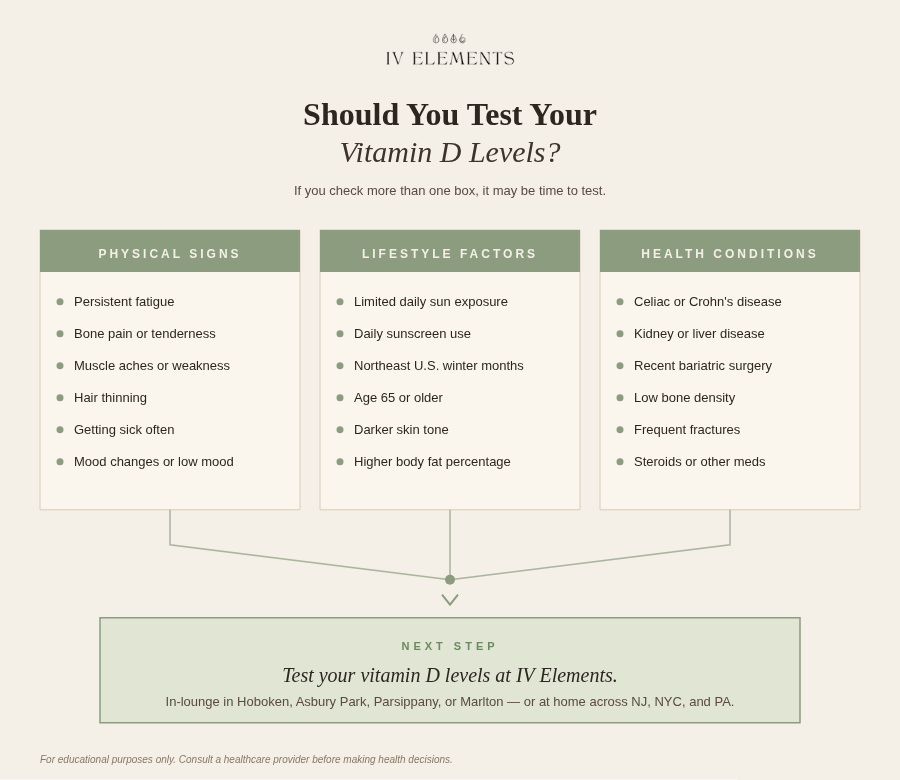
Also, if you live in the North East region, it’s often a good idea to check your levels in winter. That’s because the sun’s lower position in the sky leads to less UVB radiation, which can make it difficult to get enough sunlight no matter how much time you spend outdoors.
Where can you get vitamin D testing?
At IV Elements, we offer a micronutrients panel to test your vitamin D levels at our drip lounges in Hoboken, Asbury Park, Parsippany, and Marlton. We also provide convenient mobile services throughout New Jersey, New York City, Philadelphia and Bucks County; that means you can get your vitamin D levels checked right from the comfort of your own home.
If your levels are too low, our experienced team also offers vitamin D injections. These injections give you a safe, steady dose of the nutrient over time so your body stays healthy and balanced.
Test your vitamin D levels, get a booster shot, and explore integrative oncology care at IV Elements
Now that you understand the link between vitamin D and cancer risk, take charge of your health by testing your vitamin D levels and exploring booster shots at IV Elements. Our compassionate, experienced team can help you determine the best injection schedule to keep your levels strong.
In addition, if you or someone you love is currently in cancer recovery, we provide integrative oncology care to support your journey. As proud members of the Society for Integrative Oncology (SIO), Physicians’ Association for Anthroposophic Medicine (PAAM), and Institute of Functional Medicine (IFM), we offer recovery support services such as high-dose vitamin C and mistletoe therapy. Our skilled nurses are led by board-certified advanced practice nurse Rebecca LaMarca, who has helped treat various cancers while working at the Cancer Institute of New Jersey and is certified in mistletoe therapy. Mistletoe and vitamin C infusions are used in integrative oncology as supportive care alongside conventional treatment. Some patients report improvements in comfort and quality of life during recovery.
These treatments are available at our drip lounges in Hoboken, Asbury Park, Parsippany, and Marlton and as a mobile service throughout NJ, NYC, Philadelphia, and Bucks County.
*Disclaimer: The information on this page is for educational purposes only and is not intended as medical advice or to diagnose, treat, cure, or prevent any disease. It has not been evaluated by the FDA. Always consult a qualified healthcare professional before making health-related decisions.
Frequently Asked Questions
Is low vitamin D linked to cancer?
Some studies suggest that low vitamin D may be associated with a higher risk of certain cancers, particularly colorectal cancer. There may also be links with other cancers, like bladder cancer, but more research is needed.
Can taking vitamin D supplements prevent cancer?
No major studies have found a clear link between vitamin D supplements and a lower risk of cancer. But getting enough vitamin D (whether through diet, sunlight, supplements, or injections) is still important for overall health.
How does vitamin D support immune function?
Vitamin D helps your immune system stay balanced by supporting immune cells in their fight against infections. It also helps regulate inflammation, which can reduce overactivity that may damage healthy tissue. In addition, vitamin D influences T cells and B cells, which help support long-term immune responses.
Where can I test my vitamin D levels in NJ, NYC, and Philadelphia?
The certified team at IV Elements offers vitamin D testing at our drip lounges in Hoboken, Asbury Park, Parsippany, and Marlton, NJ. We also provide testing as a convenient in-home service across New Jersey, New York City, Philadelphia, and Bucks County.
When should I get my vitamin D levels tested?
You should get your levels tested if you show signs of low vitamin D, like fatigue, bone pain, or frequent illness. You may also want to get tested if you have high body fat, have darker skin, are over 65, or get very little sunlight, as these factors raise your risk of vitamin D deficiency.
REFERENCES
- World Health Organization. (2019). Cancer. World Health Organization: WHO. https://www.who.int/health-topics/cancer#tab=tab_1
- National Cancer Institute. (2017). Vitamin D and Cancer Prevention. National Cancer Institute; Cancer.gov. https://www.cancer.gov/about-cancer/causes-prevention/risk/diet/vitamin-d-fact-sheet
- Sanlier, N., & Guney-Coskun, M. (2022). Vitamin D, the immune system, and its relationship with diseases. Egyptian Pediatric Association Gazette, 70(1). https://doi.org/10.1186/s43054-022-00135-w
- Jeon, S.-M., & Shin, E.-A. (2018). Exploring vitamin D metabolism and function in cancer. Experimental & Molecular Medicine, 50(4). https://doi.org/10.1038/s12276-018-0038-9
- Ismailova, A., & White, J. H. (2021). Vitamin D, infections and immunity. Reviews in Endocrine and Metabolic Disorders, 23(2). https://doi.org/10.1007/s11154-021-09679-5
- Ao, T., Kikuta, J., & Ishii, M. (2021). The effects of vitamin D on immune system and inflammatory diseases. Biomolecules, 11(11), 1624. https://doi.org/10.3390/biom11111624
- White, J. H. (2022). Emerging Roles of Vitamin D-Induced Antimicrobial Peptides in Antiviral Innate Immunity. Nutrients, 14(2), 284. https://doi.org/10.3390/nu14020284
- Fleet, J. C., Burcham, G. N., Calvert, R. D., Elzey, B. D., & Ratliff, T. L. (2020). 1α, 25 Dihydroxyvitamin D (1,25(OH)2D) inhibits the T cell suppressive function of myeloid derived suppressor cells (MDSC). The Journal of Steroid Biochemistry and Molecular Biology, 198, 105557–105557. https://doi.org/10.1016/j.jsbmb.2019.105557
- Williams, J. D., Aggarwal, A., Swami, S., Krishnan, A. V., Ji, L., Albertelli, M. A., & Feldman, B. J. (2016). Tumor Autonomous Effects of Vitamin D Deficiency Promote Breast Cancer Metastasis. Endocrinology, 157(4), 1341–1347. https://doi.org/10.1210/en.2015-2036
- Chowdhury, R., Kunutsor, S., Vitezova, A., Oliver-Williams, C., Chowdhury, S., Kiefte-de-Jong, J. C., Khan, H., Baena, C. P., Prabhakaran, D., Hoshen, M. B., Feldman, B. S., Pan, A., Johnson, L., Crowe, F., Hu, F. B., & Franco, O. H. (2014). Vitamin D and risk of cause specific death: systematic review and meta-analysis of observational cohort and randomised intervention studies. BMJ, 348(apr01 2), g1903–g1903. https://doi.org/10.1136/bmj.g1903
- Weinstein, S. J., Mondul, A. M., Layne, T. M., Yu, K., Huang, J.-Q., Stolzenberg-Solomon, R. Z., Ziegler, R. G., Purdue, M. P., Wen Yi Huang, Abnet, C. C., Freedman, N. D., & Albanes, D. (2022). Prediagnostic Serum Vitamin D, Vitamin D Binding Protein Isoforms, and Cancer Survival. 6(2). https://doi.org/10.1093/jncics/pkac019
- McCullough, M. L., Zoltick, E. S., Weinstein, S. J., Fedirko, V., Wang, M., Cook, N. R., Eliassen, A. H., Zeleniuch-Jacquotte, A., Agnoli, C., Albanes, D., Barnett, M. J., Buring, J. E., Campbell, P. T., Clendenen, T. V., Freedman, N. D., Gapstur, S. M., Giovannucci, E. L., Goodman, G. G., Haiman, C. A., & Ho, G. Y. F. (2019). Circulating Vitamin D and Colorectal Cancer Risk: An International Pooling Project of 17 Cohorts. Journal of the National Cancer Institute, 111(2), 158–169. https://doi.org/10.1093/jnci/djy087
- Sluyter, J. D., Manson, J. E., & Scragg, R. (2020). Vitamin D and Clinical Cancer Outcomes: A Review of Meta‐Analyses. JBMR Plus, 5(1). https://doi.org/10.1002/jbm4.10420
- Manson, J. E., Bassuk, S. S., & Buring, J. E. (2020). Principal results of the VITamin D and OmegA-3 TriaL (VITAL) and updated meta-analyses of relevant vitamin D trials. The Journal of Steroid Biochemistry and Molecular Biology, 198, 105522. https://doi.org/10.1016/j.jsbmb.2019.105522
- Weight Loss Treatments in NJ, NYC, and PA | IV Elements. (2023, May). IV Elements. https://ivelements.net/overweight-obesity
- National Institutes of Health. (2025). Vitamin D. National Institutes of Health. https://ods.od.nih.gov/factsheets/VitaminD-HealthProfessional/
- National Institute of Arthritis and Musculoskeletal and Skin Diseases. (2023, May 5). Calcium and vitamin D: Important for bone health. National Institute of Arthritis and Musculoskeletal and Skin Diseases. https://www.niams.nih.gov/health-topics/calcium-and-vitamin-d-important-bone-health
- Cleveland Clinic. (2022, August 2). Vitamin D deficiency: Causes, symptoms & treatment. Cleveland Clinic. https://my.clevelandclinic.org/health/diseases/15050-vitamin-d-vitamin-d-deficiency
- Functional Lab Testing: Understand Abnormal Labs & What You Need To Do. (2025, November 13). IV Elements. https://ivelements.net/holistic-health-coaching-and-lab-testing
- Vitamin Booster Add-Ons for IV Therapy. (2026, April). IV Elements. https://ivelements.net/boosters
- Integrative Medicine During Chemo and Radiation | IV Therapy. (2025, November 6). IV Elements. https://ivelements.net/chemotherapy-radiation-recovery
- Schedule Your IV Therapy At-Home | Book IV Drip Now. (2024, November 4). IV Elements. https://ivelements.net/book-now-1
 Share
Share  Tweet
Tweet  Share
Share  Email
Email